
Dermacentor spp.
Synopsis
CAPC Recommends
- Year-round use of tick control for dogs and cats
- Keeping pets treated with acaricides creates a safer environment for pets and people. Pets not maintained on acaricides may bring ticks into the home which can then move to people and other pets, creating a risk of infection.
Species
Canine
Dermacentor variabilis (American dog tick)
Dermacentor andersoni (Rocky Mountain wood tick)
Feline
Dermacentor variabilis (American dog tick)
Dermacentor andersoni (Rocky Mountain wood tick)
Note: Dermacentor variabilis is now recognized to be 2 distinct species with D. variabilis occurring in the eastern United States and the new species, D. similis, occurring in the western United States
*Other Dermacentor spp. may on occasion parasitize dogs and cats
Overview of Life Cycle
- Dermacentor variabilis and D. andersoni are ‘three-host’ ticks, which means that each feeding stage (larva, nymph, and adult) will molt off the host between their requisite blood meals and then seek another host after molting to the subsequent stage.
- The life cycle of D. variabilis and D. andersoni can take three years to completion depending on environmental conditions. Females deposit a single clutch of approximately 1,500-3,000 eggs in the environment and the six-legged larval stage hatches from the egg.
- The larva must then find a host, feed for several days, and then drop to the ground and molt to an eight-legged nymph.
- The nymph then finds an appropriate host and feeds for several days to a week. Once the nymph has engorged, it drops to the ground and molts to the eight-legged adult, which then must find a third host.
- Adults may mate on or off a host, and once mated and fully engorged, the female will detach, crawl to a suitable environmental location, oviposit a clutch of several thousand eggs, and then die.
Peak activity of larval, nymphal, and adult Dermacentor spp. (phenology or timing of activity) varies with local climatic factors
Dermacentor andersoni
- Peak Larval Activity: Mid to Late Summer (Year 1)
- Peak Nymphal Activity: Summer (Year 2)
- Peak Adult Activity: Late Spring to Summer (Year 3)
Dermacentor variabilis
- Peak Larval Activity: Mid to Late Summer (Year 1)
- Peak Nymphal Activity: Summer (Year 2)
- Peak Adult Activity: Late Spring to Summer (Year 3)
Stages
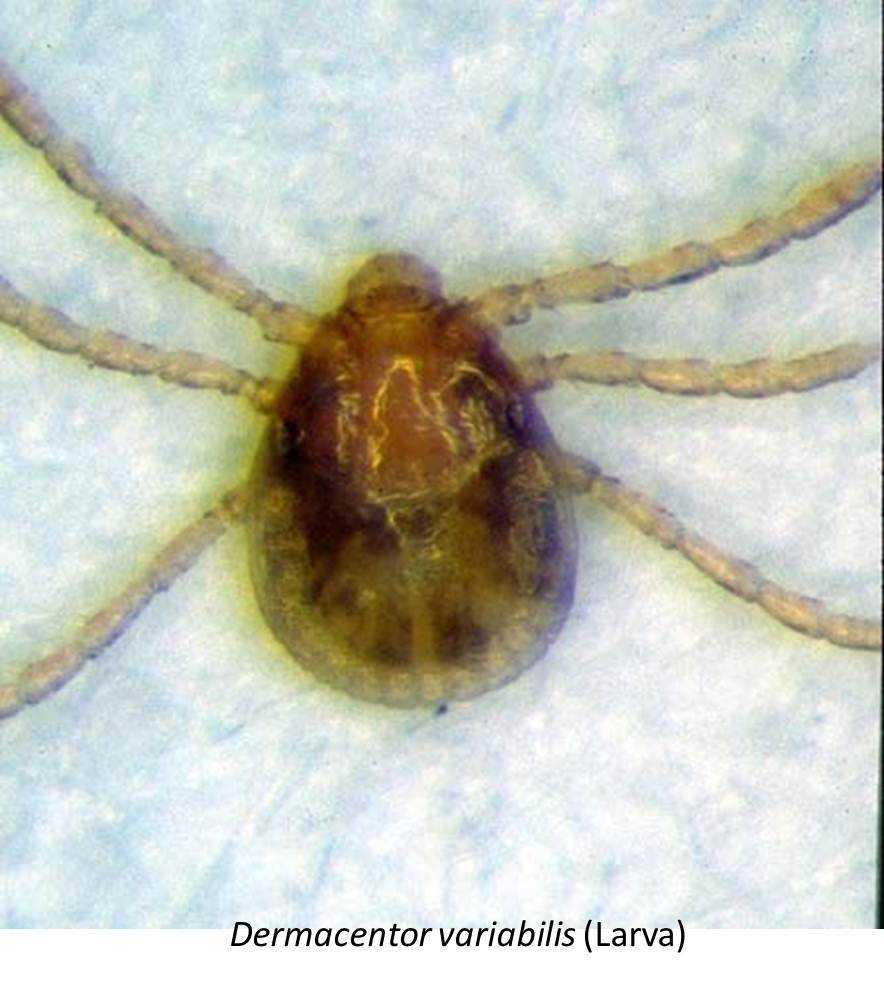
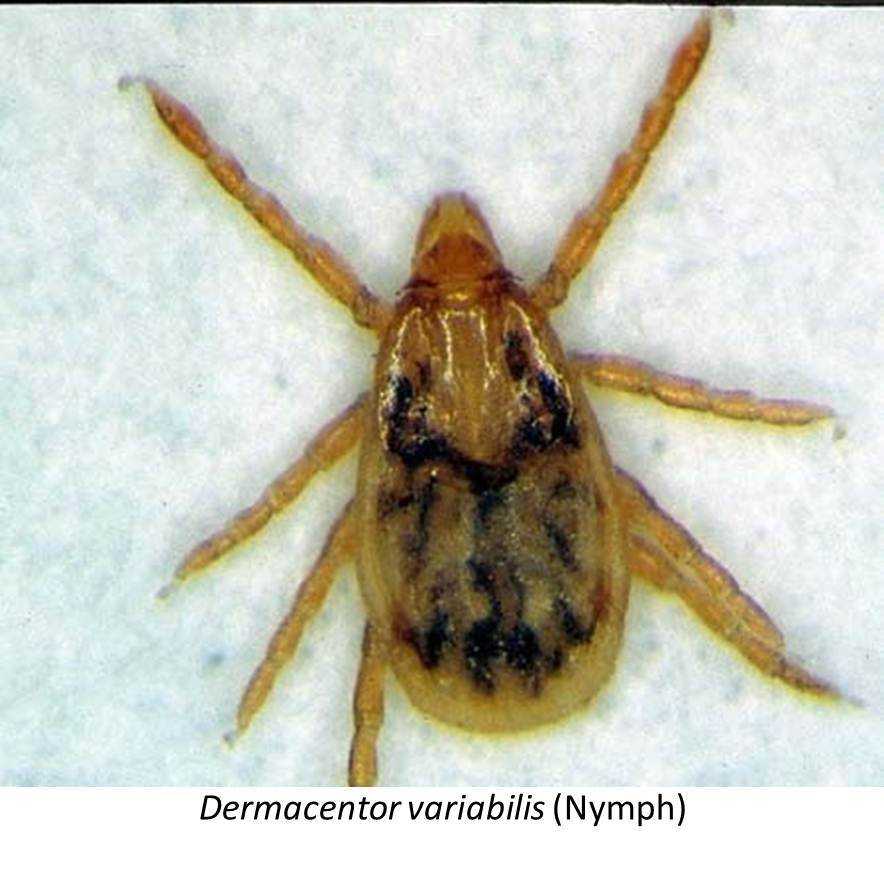
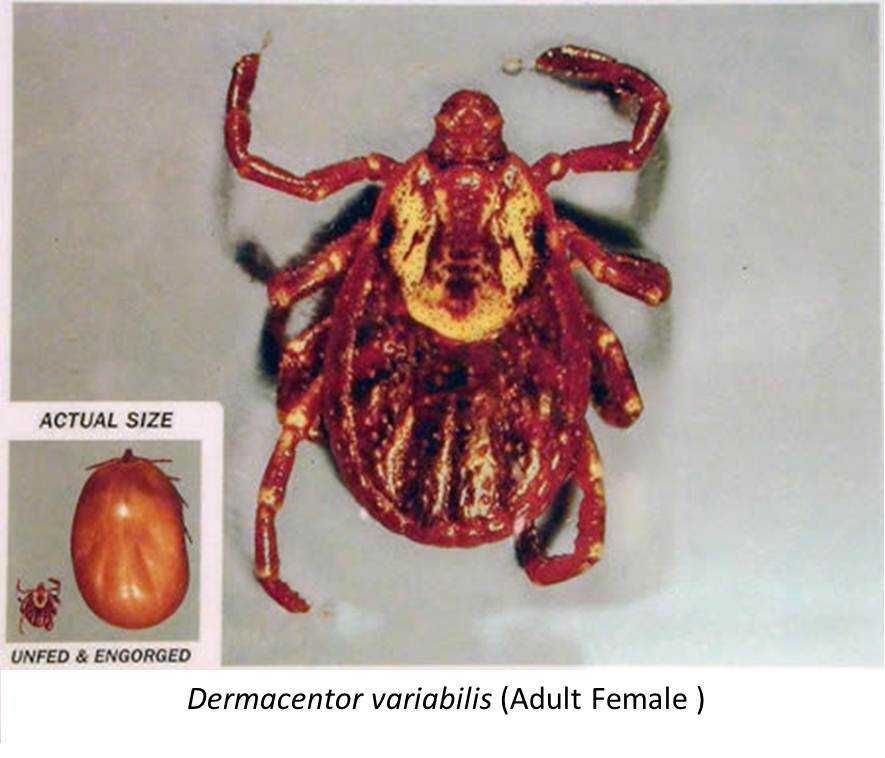
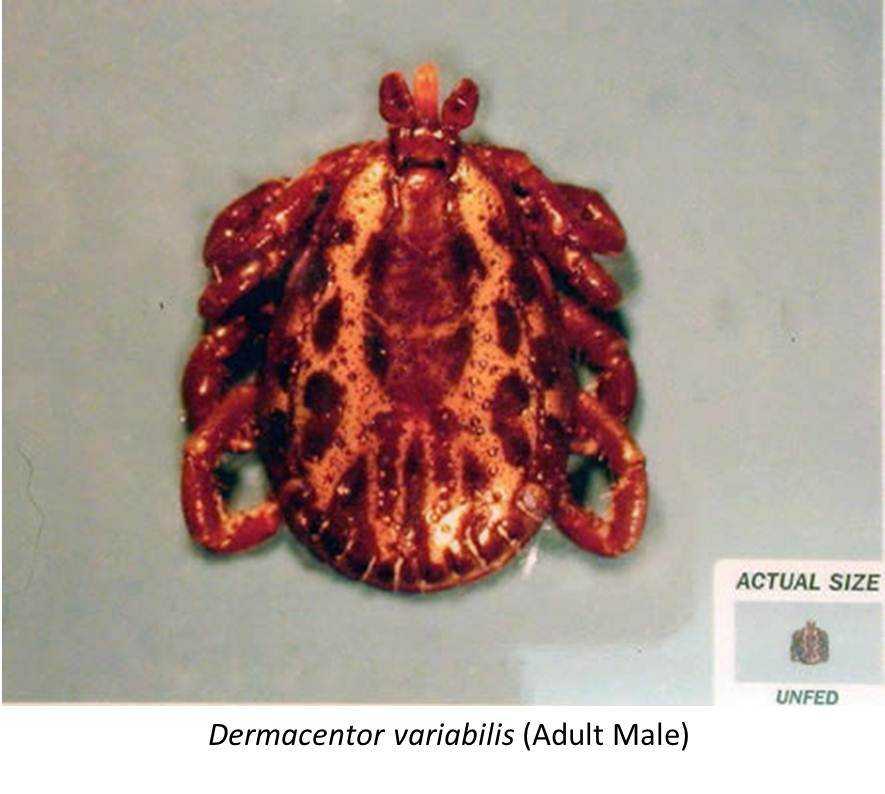
- Adults of both D. andersoni and D. variabilis are approximately 5mm and are characterized by a highly sclerotized dorsal shield (a “scutum”) that is brown with variegated white markings along the entire scutum and mouthparts that are shorter than they are wide. The scutum extends part way across the dorsum on the female, allowing expansion with feeding, and completely covers the dorsum of the male.
- Nymphs are less than 2mm and have 8 legs, while larvae are tiny (less than 1 mm) and have 6 legs.
- Both larvae and nymphs have a scutum that only extends part way across the dorsum, allowing them to expand severalfold in size as they engorge on host blood before they detach to molt to the next stage.
- The ornate white markings on the scutum are only found on the adult stages of Dermacentor spp.
Disease
Direct disease caused by tick bite
- Like any ticks, Dermacentor spp. may cause irritation and pruritus around attachment sites. Secondary infections can develop at tick attachment sites, leading to sepsis.
- In North America, tick paralysis is most commonly associated with Dermacentor variabilis and D. andersoni. This phenomenon is caused by a neurotoxin in the saliva of Dermacentor spp. ticks and can result in paralysis.
Pathogen transmission
- The feeding time required to allow disease transmission varies between ticks and disease agents. Transmission times for rickettsial diseases have not been well-established, although Rickettsia rickettsii has been transmitted to guinea pigs in a laboratory setting in under 30 minutes.
- Rickettsia rickettsii is one of the few tick-borne pathogens that can be transmitted transovarially in ticks, meaning adult females pass the pathogen on to offspring through the eggs. Up to 100% of the eggs may be infected which can result in a high number of infected larval ticks in a local area.
- Many tick-borne pathogens, including R. rickettsii, can also acquired by immature ticks when feeding as larvae or nymphs, and then transmitted by nymphs or adults in subsequent feedings after molting because the infections are maintained through developmental stages. This process is referred to as transstadial transmission.
Dermacentor variabilis
- Common Name: American dog tick
- Pathogens transmitted (Disease Name):
- Rickettsia rickettsii (Rocky Mountain spotted fever)
- Francisella tularensis (Tularemia)
Dermacentor andersoni
- Common Name: Rocky Mountain wood tick
- Pathogens transmitted (Disease Name):
- Rickettsia rickettsii (Rocky Mountain spotted fever)
- Francisella tularensis (Tularemia)
- Colorado Tick Fever Virus (Colorado Tick Fever)*
*Disease reported in humans only. Not considered to be pathogens of dogs and/or cats.
Prevalence
- Dermacentor variabilis is found throughout the eastern United States as far west as Texas, Wyoming, and Montana. Dermacentor similis, once considered to be D. variabilis, is found along the West coast. While these are now considered two distinct species, earlier publications may refer to Dermacentor variabilis found in California, Oregon, and Washington.
- Dermacentor andersoni is found in a regional cluster between the Rocky Mountains to the East and the Sierra Nevada (California) and Cascade (Oregon/Washington) mountain ranges on the West. Their range extends from northern Arizona/New Mexico up into Canada.
- Dermacentor spp. are more commonly found in tall, grassy meadows, open woods, particularly along trails, and open fields in agricultural areas.
- Tick abundance is based on the seasonal activity of the ticks in specific regions. Because different stages are active at different times, Dermacentor spp. activity extends to include most of the spring and summer
Maps showing the general distribution of the most common pet-biting species of ticks. These maps are courtesy of the CDC (https://www.cdc.gov/ticks/about/where-ticks-live.html) . Note that these tick species may occur outside of these shaded areas due to range expansion or movement on people or animals.
Host Associations and Transmission Between Hosts
Preferred hosts for Dermacentor variabilis and Dermacentor andersoni
Dermacentor variabilis
- Preferred Hosts for Immature Stages: small vertebrates in the environment, including rodents, birds, and lizards with nymphal ticks feeding on medium-sized mammals
- Preferred Hosts for Adults: Medium to large mammals, including deer, dogs, cats, horses, and cattle.
*Only adults commonly reported on dogs and cats.
Dermacentor andersoni
- Preferred Hosts for Immature Stages: small vertebrates in the environment, including rodents, birds, and lizards with nymphal ticks feeding on medium-sized mammals
- Preferred Hosts for Adults: Medium to large mammals, including deer, dogs, cats, horses, and cattle.
* Only adults commonly reported on dogs and cats.
Diagnosis
- Diagnosis is made on physical examination of host, when attached ticks are recognized and recovered.
- Key features for identifying adult Dermacentor spp. are the brown scutum with white, variegated ornamentation and short mouthparts.
- Identification of larval and nymphal ticks is more challenging, requiring microscopic examination of key morphologic features. This is most commonly performed in research or diagnostic laboratories.
- For submission to a diagnostic laboratory, ticks should be secured in specimen tubes with or without alcohol.
Treatment
- See general tick recommendations.
- Products may only be labeled against D. variabilis for dogs and cats, but those products can be assumed to be effective against other Dermacentor spp.
Control and Prevention
- Because substantial annual, seasonal, and geographic differences occur in prevalence and activity of Dermacentor spp., as well as other ticks, in North America, CAPC supports year-round use of tick-control products on pets.
- Dermacentor spp. are acquired from outdoors. However, the habitat around the home can be modified to render it less supportive of ticks and wildlife hosts that can amplify tick populations.
Public Health Considerations
- Dermacentor spp. that infest dogs and cats also feed on people and can transmit numerous zoonotic agents (described in Disease section).
- People become infested in the same way as their pets, i.e., by encountering questing ticks in tick-infested habitats.
- Pets not maintained on acaricides may bring ticks into the home which can then move to people and other pets, creating a risk of infection. Keeping pets treated with acaricides creates a safer environment for pets and people.
- The following measures are recommended to prevent human infestation with ticks and infection with tick-borne disease agents. These recommendations are applicable to prevent infestations with Ixodes spp. and many other tick species from natural environments.
- Maintain pets on tick-control products year-round.
- Avoid tick-infested areas whenever possible.
- Wear light-colored clothing when entering infested areas to facilitate visualization of ticks as they crawl on clothing.
- Tuck pant cuffs into socks to limit tick access to legs.
- Walk in the center of trails; avoid vegetation at trail margins.
- Use a chemical repellent such as DEET, picaridin, or permethrin.
- Perform frequent tick checks when vacationing or visiting tick-infested areas. It is especially important that such checks be performed on children.
- Shower, shampoo, and put on clean clothes after visiting areas where ticks might be present.
- When a tick is found on a person, remove it with fine forceps. Prompt removal is necessary; some rickettsial infections can be transmitted after as little as 3-6 hours of tick feeding.
- Save the removed tick, wrapped in cellophane tape or in a vial with alcohol, for future identification if needed. The tape or vial can be sealed in a plastic bag, labeled with the date found, and frozen. If illness develops, identification of the tick and the day it was discovered may aid the physician in recognizing which infection was most likely transmitted and allow prompt, appropriate treatment.
Selected references
- Saleh MN, Sundstrom KD, Duncan KT, Ientile MM, Jordy J, Ghosh P, Little SE. Show us your ticks: a survey of ticks infesting dogs and cats across the USA. Parasit Vectors. 2019 Dec 19;12(1):595. doi: 10.1186/s13071-019-3847-3. Erratum in: Parasit Vectors. 2021 Feb 22;14(1):117. doi: 10.1186/s13071-021-04599-4. PMID: 31856893; PMCID: PMC6923977.
- Duncan KT, Saleh MN, Sundstrom KD, Little SE. Dermacentor variabilis is the Predominant Dermacentor spp. (Acari: Ixodidae) Feeding on Dogs and Cats Throughout the United States. J Med Entomol. 2021 May 15;58(3):1241-1247. doi: 10.1093/jme/tjab007. PMID: 33615364; PMCID: PMC8122232.
- Duncan KT, Grant A, Johnson B, Sundstrom KD, Saleh MN, Little SE. Identification of Rickettsia spp. and Babesia conradae in Dermacentor spp. Collected from Dogs and Cats Across the United States. Vector Borne Zoonotic Dis. 2021 Dec;21(12):911-920. doi: 10.1089/vbz.2021.0047. PMID: 34958266; PMCID: PMC8742288.
- Saleh MN, Allen KE, Lineberry MW, Little SE, Reichard MV. Ticks infesting dogs and cats in North America: Biology, geographic distribution, and pathogen transmission. Vet Parasitol. 2021 Jun;294:109392. doi: 10.1016/j.vetpar.2021.109392. Epub 2021 Feb 19. PMID: 33971481; PMCID: PMC9235321.
Synopsis
CAPC Recommends
- Year-round use of tick control for dogs and cats
- Keeping pets treated with acaricides creates a safer environment for pets and people. Pets not maintained on acaricides may bring ticks into the home which can then move to people and other pets, creating a risk of infection.
Species
Canine
Dermacentor variabilis (American dog tick)
Dermacentor andersoni (Rocky Mountain wood tick)
Feline
Dermacentor variabilis (American dog tick)
Dermacentor andersoni (Rocky Mountain wood tick)
Note: Dermacentor variabilis is now recognized to be 2 distinct species with D. variabilis occurring in the eastern United States and the new species, D. similis, occurring in the western United States
*Other Dermacentor spp. may on occasion parasitize dogs and cats
Overview of Life Cycle
- Dermacentor variabilis and D. andersoni are ‘three-host’ ticks, which means that each feeding stage (larva, nymph, and adult) will molt off the host between their requisite blood meals and then seek another host after molting to the subsequent stage.
- The life cycle of D. variabilis and D. andersoni can take three years to completion depending on environmental conditions. Females deposit a single clutch of approximately 1,500-3,000 eggs in the environment and the six-legged larval stage hatches from the egg.
- The larva must then find a host, feed for several days, and then drop to the ground and molt to an eight-legged nymph.
- The nymph then finds an appropriate host and feeds for several days to a week. Once the nymph has engorged, it drops to the ground and molts to the eight-legged adult, which then must find a third host.
- Adults may mate on or off a host, and once mated and fully engorged, the female will detach, crawl to a suitable environmental location, oviposit a clutch of several thousand eggs, and then die.
Peak activity of larval, nymphal, and adult Dermacentor spp. (phenology or timing of activity) varies with local climatic factors
Dermacentor andersoni
- Peak Larval Activity: Mid to Late Summer (Year 1)
- Peak Nymphal Activity: Summer (Year 2)
- Peak Adult Activity: Late Spring to Summer (Year 3)
Dermacentor variabilis
- Peak Larval Activity: Mid to Late Summer (Year 1)
- Peak Nymphal Activity: Summer (Year 2)
- Peak Adult Activity: Late Spring to Summer (Year 3)
Stages
- Adults of both D. andersoni and D. variabilis are approximately 5mm and are characterized by a highly sclerotized dorsal shield (a “scutum”) that is brown with variegated white markings along the entire scutum and mouthparts that are shorter than they are wide. The scutum extends part way across the dorsum on the female, allowing expansion with feeding, and completely covers the dorsum of the male.
- Nymphs are less than 2mm and have 8 legs, while larvae are tiny (less than 1 mm) and have 6 legs.
- Both larvae and nymphs have a scutum that only extends part way across the dorsum, allowing them to expand severalfold in size as they engorge on host blood before they detach to molt to the next stage.
- The ornate white markings on the scutum are only found on the adult stages of Dermacentor spp.
Disease
Direct disease caused by tick bite
- Like any ticks, Dermacentor spp. may cause irritation and pruritus around attachment sites. Secondary infections can develop at tick attachment sites, leading to sepsis.
- In North America, tick paralysis is most commonly associated with Dermacentor variabilis and D. andersoni. This phenomenon is caused by a neurotoxin in the saliva of Dermacentor spp. ticks and can result in paralysis.
Pathogen transmission
- The feeding time required to allow disease transmission varies between ticks and disease agents. Transmission times for rickettsial diseases have not been well-established, although Rickettsia rickettsii has been transmitted to guinea pigs in a laboratory setting in under 30 minutes.
- Rickettsia rickettsii is one of the few tick-borne pathogens that can be transmitted transovarially in ticks, meaning adult females pass the pathogen on to offspring through the eggs. Up to 100% of the eggs may be infected which can result in a high number of infected larval ticks in a local area.
- Many tick-borne pathogens, including R. rickettsii, can also acquired by immature ticks when feeding as larvae or nymphs, and then transmitted by nymphs or adults in subsequent feedings after molting because the infections are maintained through developmental stages. This process is referred to as transstadial transmission.
Dermacentor variabilis
- Common Name: American dog tick
- Pathogens transmitted (Disease Name):
- Rickettsia rickettsii (Rocky Mountain spotted fever)
- Francisella tularensis (Tularemia)
Dermacentor andersoni
- Common Name: Rocky Mountain wood tick
- Pathogens transmitted (Disease Name):
- Rickettsia rickettsii (Rocky Mountain spotted fever)
- Francisella tularensis (Tularemia)
- Colorado Tick Fever Virus (Colorado Tick Fever)*
*Disease reported in humans only. Not considered to be pathogens of dogs and/or cats.
Prevalence
- Dermacentor variabilis is found throughout the eastern United States as far west as Texas, Wyoming, and Montana. Dermacentor similis, once considered to be D. variabilis, is found along the West coast. While these are now considered two distinct species, earlier publications may refer to Dermacentor variabilis found in California, Oregon, and Washington.
- Dermacentor andersoni is found in a regional cluster between the Rocky Mountains to the East and the Sierra Nevada (California) and Cascade (Oregon/Washington) mountain ranges on the West. Their range extends from northern Arizona/New Mexico up into Canada.
- Dermacentor spp. are more commonly found in tall, grassy meadows, open woods, particularly along trails, and open fields in agricultural areas.
- Tick abundance is based on the seasonal activity of the ticks in specific regions. Because different stages are active at different times, Dermacentor spp. activity extends to include most of the spring and summer
Maps showing the general distribution of the most common pet-biting species of ticks. These maps are courtesy of the CDC (https://www.cdc.gov/ticks/about/where-ticks-live.html) . Note that these tick species may occur outside of these shaded areas due to range expansion or movement on people or animals.
Host Associations and Transmission Between Hosts
Preferred hosts for Dermacentor variabilis and Dermacentor andersoni
Dermacentor variabilis
- Preferred Hosts for Immature Stages: small vertebrates in the environment, including rodents, birds, and lizards with nymphal ticks feeding on medium-sized mammals
- Preferred Hosts for Adults: Medium to large mammals, including deer, dogs, cats, horses, and cattle.
*Only adults commonly reported on dogs and cats.
Dermacentor andersoni
- Preferred Hosts for Immature Stages: small vertebrates in the environment, including rodents, birds, and lizards with nymphal ticks feeding on medium-sized mammals
- Preferred Hosts for Adults: Medium to large mammals, including deer, dogs, cats, horses, and cattle.
* Only adults commonly reported on dogs and cats.
Diagnosis
- Diagnosis is made on physical examination of host, when attached ticks are recognized and recovered.
- Key features for identifying adult Dermacentor spp. are the brown scutum with white, variegated ornamentation and short mouthparts.
- Identification of larval and nymphal ticks is more challenging, requiring microscopic examination of key morphologic features. This is most commonly performed in research or diagnostic laboratories.
- For submission to a diagnostic laboratory, ticks should be secured in specimen tubes with or without alcohol.
Treatment
- See general tick recommendations.
- Products may only be labeled against D. variabilis for dogs and cats, but those products can be assumed to be effective against other Dermacentor spp.
Control and Prevention
- Because substantial annual, seasonal, and geographic differences occur in prevalence and activity of Dermacentor spp., as well as other ticks, in North America, CAPC supports year-round use of tick-control products on pets.
- Dermacentor spp. are acquired from outdoors. However, the habitat around the home can be modified to render it less supportive of ticks and wildlife hosts that can amplify tick populations.
Public Health Considerations
- Dermacentor spp. that infest dogs and cats also feed on people and can transmit numerous zoonotic agents (described in Disease section).
- People become infested in the same way as their pets, i.e., by encountering questing ticks in tick-infested habitats.
- Pets not maintained on acaricides may bring ticks into the home which can then move to people and other pets, creating a risk of infection. Keeping pets treated with acaricides creates a safer environment for pets and people.
- The following measures are recommended to prevent human infestation with ticks and infection with tick-borne disease agents. These recommendations are applicable to prevent infestations with Ixodes spp. and many other tick species from natural environments.
- Maintain pets on tick-control products year-round.
- Avoid tick-infested areas whenever possible.
- Wear light-colored clothing when entering infested areas to facilitate visualization of ticks as they crawl on clothing.
- Tuck pant cuffs into socks to limit tick access to legs.
- Walk in the center of trails; avoid vegetation at trail margins.
- Use a chemical repellent such as DEET, picaridin, or permethrin.
- Perform frequent tick checks when vacationing or visiting tick-infested areas. It is especially important that such checks be performed on children.
- Shower, shampoo, and put on clean clothes after visiting areas where ticks might be present.
- When a tick is found on a person, remove it with fine forceps. Prompt removal is necessary; some rickettsial infections can be transmitted after as little as 3-6 hours of tick feeding.
- Save the removed tick, wrapped in cellophane tape or in a vial with alcohol, for future identification if needed. The tape or vial can be sealed in a plastic bag, labeled with the date found, and frozen. If illness develops, identification of the tick and the day it was discovered may aid the physician in recognizing which infection was most likely transmitted and allow prompt, appropriate treatment.
Selected references
- Saleh MN, Sundstrom KD, Duncan KT, Ientile MM, Jordy J, Ghosh P, Little SE. Show us your ticks: a survey of ticks infesting dogs and cats across the USA. Parasit Vectors. 2019 Dec 19;12(1):595. doi: 10.1186/s13071-019-3847-3. Erratum in: Parasit Vectors. 2021 Feb 22;14(1):117. doi: 10.1186/s13071-021-04599-4. PMID: 31856893; PMCID: PMC6923977.
- Duncan KT, Saleh MN, Sundstrom KD, Little SE. Dermacentor variabilis is the Predominant Dermacentor spp. (Acari: Ixodidae) Feeding on Dogs and Cats Throughout the United States. J Med Entomol. 2021 May 15;58(3):1241-1247. doi: 10.1093/jme/tjab007. PMID: 33615364; PMCID: PMC8122232.
- Duncan KT, Grant A, Johnson B, Sundstrom KD, Saleh MN, Little SE. Identification of Rickettsia spp. and Babesia conradae in Dermacentor spp. Collected from Dogs and Cats Across the United States. Vector Borne Zoonotic Dis. 2021 Dec;21(12):911-920. doi: 10.1089/vbz.2021.0047. PMID: 34958266; PMCID: PMC8742288.
- Saleh MN, Allen KE, Lineberry MW, Little SE, Reichard MV. Ticks infesting dogs and cats in North America: Biology, geographic distribution, and pathogen transmission. Vet Parasitol. 2021 Jun;294:109392. doi: 10.1016/j.vetpar.2021.109392. Epub 2021 Feb 19. PMID: 33971481; PMCID: PMC9235321.