Cochliomyia hominivorax
Cochliomyia hominivorax for Dog Last updated: Aug 14, 2026
Current Status and Updates (As of August 14, 2026)
- There have been multiple cases of New World Screwworm reported in Texas and New Mexico.
- The most up-to-date information on the current status, response, and guidelines for NWS can be found at the USDA APHIS website: www.screwworm.gov
- For a map of confirmed USDA detected cases of New World Screwworm click here
- Reporting suspect or confirmed cases of screwworm
- Contact the APHIS VS Area Veterinarian in Charge (AVIC) for your state and your State Animal Health Officials (SAHO) (https://usaha.org/saho/) to report suspect or confirmed cases of screwworm.
- Additionally, the APHIS VS Live Animal Import unit should be contacted for imported animals.
- The US Food and Drug Administration has granted conditional approval for the following products for treatment of NWS in dogs:
- Credelio Quattro™-CA1 (lotilaner, moxidectin, praziquantel, pyrantel) – dogs, puppies
- The US Food and Drug Administration has issued Emergency Use Authorization (EUA) for the following products for treatment of NWS in dogs and cats:
- NexGard® (afoxolaner) chewable tablets – dogs
- NexGard® COMBO (esafoxolaner, eprinomectin, praziquantel) topical – cats
- Credelio™ (lotilaner) chewable – dogs, puppies
- Credelio™ CAT (lotilaner) chewable – cats, kittens
- Generic nitenpyram tablets - dogs and cats weighing at least 2 lb and that are at least four weeks old
- Simparica Trio® (sarolaner, moxidectin, and pyrantel chewable tablets) - dogs, puppies
- The US Food and Drug Administration updates for veterinarians regarding conditional approvals, emergency use authorizations and extra label use of drugs for NWS can be found on their website: https://www.fda.gov/animal-vet...
Synopsis
CAPC Recommends
- Maintain companion animals on a year-round ectoparasite control product.
- Monitor wounds and any suspect fly larvae found on wounds of companion animals should be identified to rule out NWS infestation.
- Monitor animals if traveling to areas where NWS outbreaks have been reported or endemic areas.
- Report any suspected or confirmed NWS cases immediately to the APHIS VS Area Veterinarian in Charge (AVIC) for your state and your State Animal Health Officials (SAHO) (https://usaha.org/saho/). NWS is a reportable condition.
Species
Feline
Canine
Cochliomyia hominivorax - New World Screwworm

Cochliomyia hominivorax 3rd instar larva

Cochliomyia hominivorax 3rd lnstar larva - anterior end

Cochliomyia hominivorax 3rd instar larva - tracheal trunks
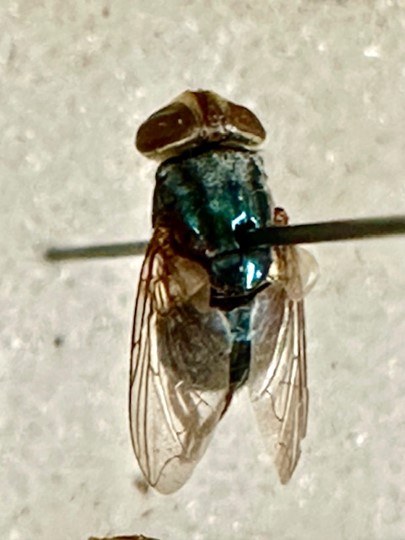
NWS adult fly
Overview of Life Cycle
- Cochliomyia hominivorax undergo obligatory myiasis. Adult females mate once and are oviparous. Females lay several hundred eggs at a time on the host near open wounds or body orifices (sites of castration or the umbilicus are common locations).
- Development is dependent upon temperature and relative humidity, preferring average temperatures of 25C and 30-70% RH.
- The eggs hatch within 24 hours and the larvae feed on living tissue.
- The larvae mature in 5-7 days, drop off the host, and pupate in the environment.
- The adult screwworm lives for approximately 7-10 days.
Stages
Adult fly
- Metallic blue-green body with reddish eyes and 3 prominent longitudinal stripes on the dorsal thorax.
Larvae
- Mature 3rd instar larvae are approximately 15 mm in length. They are pointed anteriorly and truncated posteriorly. They are identified based on morphological characteristics including the species specific spiracular plates on the posterior end and consistently dark tracheal trunks.
- The larval stage consumes healthy flesh in the affected animal.
Prevalence
- Cochliomyia hominivorax was historically found throughout the southern United States, Central America, and the northern countries of South America.
- Eradication efforts eliminated C. hominivorax from the United States, Mexico, Central America, and several Caribbean islands. Until 2022, C. hominivorax was restricted to South America and parts of the Caribbean islands.
- The Darien Gap in Panama previously served as a biological barrier against the northern spread of C. hominivorax from South America until a nationwide outbreak was declared in Panama in 2023.
- Today, C. hominivorax is found throughout Central America, parts of Mexico, South America, and several Caribbean islands.
- A confirmed outbreak of C. hominivorax in the United States occurred in 2016 in a population of Key Deer in the Florida Keys until it was successfully eradicated in early 2017.
Diagnosis
- New World screwworm (NWS) infestation is typically associated with the presence of a pre-existing wound, such as the naval of newborn animals, open cuts, open insect/tick bite wounds, etc.; however, infestation around mucous membranes or skin fold areas may also occur. Wounds may be malodorous and produce suppurative or serosanguinous discharge. The wounds may have secondary bacterial infection. Depending on the severity of the infection, animals may show signs of systemic illness.
- Differential diagnoses for NWS myiasis should include any blow fly which can infest wounds, including Cochliomyia macellaria (secondary screwworm) and Phormia regina (black blow fly).
- NWS myiasis is a reportable disease and State and Federal animal health officials must be notified, even suspect cases should be reported. If NWS myiasis is suspected the APHIS VS Area Veterinarian in Charge (AVIC) and the State Animal Health Official (SAHO) must be notified to initiate a foreign animal disease investigation. Additionally, for imported animals the APHIS VS Live Animal Import unit must be contacted.
- NWS infestation should be considered in any case of myiasis. Larvae should be collected from affected animals using forceps. It is recommended to collect larvae from the deepest area of the wound to avoid collecting secondary agents of myiasis. If possible, collect larvae of different sizes. If found, eggs can also be collected for evaluation. Samples should be saved in 70% ethanol or isopropyl alcohol; do not use formalin.
- Samples of suspected screwworm must be sent to the National Veterinary Services Laboratories (NVSL) in Ames, Iowa for identification (https://www.aphis.usda.gov/labs/diagnostic-testing).
- It is important to not collect and/or send samples without first consulting with the APHIS VS AVIC or SAHO. A Foreign Animal Disease Diagnostician will be responsible for collecting samples in most cases.
Treatment
- Do not initiate treatment before contacting appropriate state and federal agencies.
- Treatment of NWS infestations involves removing visible eggs and larvae from the wound. The wound should then be thoroughly cleaned.
- Depending on severity, the animal may need extensive wound care, systemic antimicrobials, and analgesics.
- There are currently no fully labeled ectoparasiticides for the treatment of C. hominivorax in dogs and cats in the United States. However, several products have shown high efficacy through combined larvicidal and larval expulsion activities when administered at recommended flea and tick doses.
- As of December 2025, the US Food and Drug Administration has granted conditional approval for the following products for treatment of NWS in dogs:
- Credelio Quattro™-CA1 (lotilaner, moxidectin, praziquantel, pyrantel) – dogs, puppies
- As of August 2026, the US Food and Drug Administration has issued Emergency Use Authorization (EUA) for the following products for treatment of NWS in dogs and cats:
- NexGard® (afoxolaner) chewable tablets – dogs
- NexGard® COMBO (esafoxolaner, eprinomectin, praziquantel) topical – cats
- Credelio™ (lotilaner) chewable – dogs, puppies
- Credelio™ CAT (lotilaner) chewable – cats, kittens
- Generic nitenpyram tablets - dogs and cats weighing at least 2 lb and that are at least four weeks old
- Simparica Trio® (sarolaner, moxidectin, and pyrantel chewable tablets) - dogs, puppies
- The isoxazolines afoxolaner, lotilaner, and sarolaner have demonstrated 100% overall efficacy in treating dogs naturally infested with C. hominivorax when administered at standard monthly doses.
- Nitenpyram is larvicidal and has also shown 100% efficacy in affected animals following two treatments administered 6 hours apart.
- Spinosad may be a viable extra label alternative to the isoxazolines and nitenpyram, however it has a reduced overall efficacy of 79.7% in affected animals when administered as a single oral dose. Spinosad combined with milbemycin resulted in a faster ‘time to cure’ compared to spinosad alone.
- Regardless of the ectoparasiticide utilized, the mechanical removal of visible larvae and eggs from the wound and supportive care should always be used in conjunction with any larvicidal treatment.
Control and Prevention
- NWS was eradicated in the United States in the 1950’s and 60’s, with only sporadic cases since. The mainstay of preventing NWS re-entry to the United States is sanitary and medical prophylaxis. Any animal that is imported from endemic areas should be inspected thoroughly and treated with approved insecticides.
- Prevention of NWS infestation has traditionally focused on livestock due to the massive economic impact NWS had on the industry. Studies show that the use of macrocyclic lactones, such as ivermectin and doramectin, are effective at preventing and treating NWS infestation.
- The sterile insect technique (SIT) is the mainstay of eradication efforts of NWS since the 1950s. This technique relies on the release of large numbers of sterile C. hominivorax into endemic areas so sterile males mate with wild type female flies resulting in the production of nonviable eggs. Gradually, this practice will reduce and ultimately eliminate C. hominivorax populations. The SIT is effective since the female C. hominivorax only mates once in her lifetime.
- Currently, only the Commission for the Eradication and Prevention of Screwworm (COPEG) facility in Panama produces sterile C. hominivorax.
Public Health and Eradication
- NWS is important to both human and veterinary medicine due to its zoonotic potential. Before the eradication program, C. hominivorax caused significant production losses in livestock in the United States and Mexico. The eradication program was launched in 1957 by releasing sterile flies into and around areas with NWS populations. Since then, NWS had been eliminated in most areas north of Panama, including the United States and Mexico until the most recent outbreak in 2022.
- As of Fall 2025, NWS has expanded past the former biological barrier in Panama and is found throughout Central America and to Northern Mexico.
- Since 2023, human cases of C. hominivorax infestations have been documented in all Central American countries and Mexico. In August 2025, a travel-associated case of NWS infestation was diagnosed in a person in Maryland that had recently returned from El Salvador (first U.S. human case in 50 years).
- In response to the northward spread of NWS, the USDA has deployed over 100 NWS specific traps and lures along the southern border. Wildlife captured in high-risk counties in Texas are also monitored for signs of infestation.
- The USDA is currently collaborating with Mexico to help combat the C. hominivorax outbreak. Sterile flies are continually being released in Mexico and areas of South Texas in an effort to establish a new biological barrier. In November 2025, a sterile fly dispersal facility was opened in Tampico, Mexico that will allow for the aerial release of insects in the northeastern part of the country.
- An existing fruit fly facility in Metapa, Mexico is being converted to a sterile C. hominivorax production facility that is anticipated to begin operations in 2026. Once complete, this will double the current sterile C. hominivorax production capacity.
- Additionally, the USDA has opened a sterile insect dispersal facility at the Moore Air Base in Texas and construction of a production facility in Southern Texas is underway.
Selected References
- Anziani, O.S., et al. "Persistent activity of doramectin and ivermectin in the prevention of cutaneous myiasis in cattle experimentally infested with Cochliomyia hominivorax." Veterinary Parasitology, vol. 87, nos. 2-3, Jan. 2000, pp. 243-47.
- Correia, T. R., et al. "Larvicidal efficacy of nitenpyram on the treatment of myiasis caused by Cochliomyia hominivorax (Diptera: Calliphoridae) in dogs." Veterinary Parasitology, vol. 173, nos. 1-2, 2010, pp. 169-72.
- Cutolo, A. A., et al. “Efficacy of afoxolaner (NexGard®) on the treatment of myiasis caused by the New World screwworm fly Cochliomyia hominivorax (Diptera: Calliphoridae) in naturally infested dogs.” Veterinary Parasitology: Regional Studies and Reports, vol. 24, 2021.
- de Oliveira, P. C., et al. “Efficacy of sarolaner on the treatment of myiasis caused by Cochliomyia hominivorax (Diptera: Calliphoridae) in dogs.” Veterinary Parasitology, vol. 276, 2019.
- do Vale, T. L., et al. “Efficacy of lotilaner against myiasis caused by Cochliomyia hominivorax (Diptera: Calliphoridae) in naturally infested dogs.” Parasites & Vectors, 16:86, 2023.
- Han, H. S., et al. “The comparative efficacy of afoxolaner, spinosad, milbemycin, spinosad plus milbemycine, and nitenpyram for the treatment of canine cutaneous myiasis.” Veterinary Dermatology, 2018. 29:312-e109.
- Oliveira, P. C., et al. “Efficacy of Spinosad on the treatment of myiasis caused by Cochliomyia hominivorax (Diptera: Calliphoridae) in dogs.” Veterinary Parasitology, vol. 258, July 2018, pp. 53-56.
- Orcutt, C., DVM. (2017). Avian and Exotic News. Journal of Exotic Pet Medicine, 26(2), 93-95.
- "Screwworm (Old World and New World)." World Organisation for Animal Health, www.oie.int/fileadmin/Home/eng/Animal_Health_in_the_World/docs/pdf/Disease_cards/SCREWWORM.pdf. Accessed 3 May 2017.
- Spradberry, J. P., et al. "The efficacy of ivermectin against larvae of the screw-worm fly (Chrysomya bezziana)." Australian Veterinary Journal, vol. 62, no. 9, Sept. 1985, pp. 311-14.
- Wall, Richard, and David Schearer. "Myiasis." Veterinary Entomology, Chapman & Hall, 1992, pp.197-232.
- Wyss, J. H. (2000), Screwworm Eradication in the Americas. Annals of the New York Academy of Sciences, 916: 186–193. doi:10.1111/j.1749-6632.2000.tb05289.
Current Status and Updates (As of August 14, 2026)
- There have been multiple cases of New World Screwworm reported in Texas and New Mexico.
- The most up-to-date information on the current status, response, and guidelines for NWS can be found at the USDA APHIS website: www.screwworm.gov
- For a map of confirmed USDA detected cases of New World Screwworm click here
- Reporting suspect or confirmed cases of screwworm
- Contact the APHIS VS Area Veterinarian in Charge (AVIC) for your state and your State Animal Health Officials (SAHO) (https://usaha.org/saho/) to report suspect or confirmed cases of screwworm.
- Additionally, the APHIS VS Live Animal Import unit should be contacted for imported animals.
- The US Food and Drug Administration has granted conditional approval for the following products for treatment of NWS in dogs:
- Credelio Quattro™-CA1 (lotilaner, moxidectin, praziquantel, pyrantel) – dogs, puppies
- The US Food and Drug Administration has issued Emergency Use Authorization (EUA) for the following products for treatment of NWS in dogs and cats:
- NexGard® (afoxolaner) chewable tablets – dogs
- NexGard® COMBO (esafoxolaner, eprinomectin, praziquantel) topical – cats
- Credelio™ (lotilaner) chewable – dogs, puppies
- Credelio™ CAT (lotilaner) chewable – cats, kittens
- Generic nitenpyram tablets - dogs and cats weighing at least 2 lb and that are at least four weeks old
- Simparica Trio® (sarolaner, moxidectin, and pyrantel chewable tablets) - dogs, puppies
- The US Food and Drug Administration updates for veterinarians regarding conditional approvals, emergency use authorizations and extra label use of drugs for NWS can be found on their website: https://www.fda.gov/animal-vet...
Synopsis
CAPC Recommends
- Maintain companion animals on a year-round ectoparasite control product.
- Monitor wounds and any suspect fly larvae found on wounds of companion animals should be identified to rule out NWS infestation.
- Monitor animals if traveling to areas where NWS outbreaks have been reported or endemic areas.
- Report any suspected or confirmed NWS cases immediately to the APHIS VS Area Veterinarian in Charge (AVIC) for your state and your State Animal Health Officials (SAHO) (https://usaha.org/saho/). NWS is a reportable condition.
Species
Feline
Canine
Cochliomyia hominivorax - New World Screwworm
Cochliomyia hominivorax 3rd instar larva
Cochliomyia hominivorax 3rd lnstar larva - anterior end
Cochliomyia hominivorax 3rd instar larva - tracheal trunks
NWS adult fly
Overview of Life Cycle
- Cochliomyia hominivorax undergo obligatory myiasis. Adult females mate once and are oviparous. Females lay several hundred eggs at a time on the host near open wounds or body orifices (sites of castration or the umbilicus are common locations).
- Development is dependent upon temperature and relative humidity, preferring average temperatures of 25C and 30-70% RH.
- The eggs hatch within 24 hours and the larvae feed on living tissue.
- The larvae mature in 5-7 days, drop off the host, and pupate in the environment.
- The adult screwworm lives for approximately 7-10 days.
Stages
Adult fly
- Metallic blue-green body with reddish eyes and 3 prominent longitudinal stripes on the dorsal thorax.
Larvae
- Mature 3rd instar larvae are approximately 15 mm in length. They are pointed anteriorly and truncated posteriorly. They are identified based on morphological characteristics including the species specific spiracular plates on the posterior end and consistently dark tracheal trunks.
- The larval stage consumes healthy flesh in the affected animal.
Prevalence
- Cochliomyia hominivorax was historically found throughout the southern United States, Central America, and the northern countries of South America.
- Eradication efforts eliminated C. hominivorax from the United States, Mexico, Central America, and several Caribbean islands. Until 2022, C. hominivorax was restricted to South America and parts of the Caribbean islands.
- The Darien Gap in Panama previously served as a biological barrier against the northern spread of C. hominivorax from South America until a nationwide outbreak was declared in Panama in 2023.
- Today, C. hominivorax is found throughout Central America, parts of Mexico, South America, and several Caribbean islands.
- A confirmed outbreak of C. hominivorax in the United States occurred in 2016 in a population of Key Deer in the Florida Keys until it was successfully eradicated in early 2017.
Diagnosis
- New World screwworm (NWS) infestation is typically associated with the presence of a pre-existing wound, such as the naval of newborn animals, open cuts, open insect/tick bite wounds, etc.; however, infestation around mucous membranes or skin fold areas may also occur. Wounds may be malodorous and produce suppurative or serosanguinous discharge. The wounds may have secondary bacterial infection. Depending on the severity of the infection, animals may show signs of systemic illness.
- Differential diagnoses for NWS myiasis should include any blow fly which can infest wounds, including Cochliomyia macellaria (secondary screwworm) and Phormia regina (black blow fly).
- NWS myiasis is a reportable disease and State and Federal animal health officials must be notified, even suspect cases should be reported. If NWS myiasis is suspected the APHIS VS Area Veterinarian in Charge (AVIC) and the State Animal Health Official (SAHO) must be notified to initiate a foreign animal disease investigation. Additionally, for imported animals the APHIS VS Live Animal Import unit must be contacted.
- NWS infestation should be considered in any case of myiasis. Larvae should be collected from affected animals using forceps. It is recommended to collect larvae from the deepest area of the wound to avoid collecting secondary agents of myiasis. If possible, collect larvae of different sizes. If found, eggs can also be collected for evaluation. Samples should be saved in 70% ethanol or isopropyl alcohol; do not use formalin.
- Samples of suspected screwworm must be sent to the National Veterinary Services Laboratories (NVSL) in Ames, Iowa for identification (https://www.aphis.usda.gov/labs/diagnostic-testing).
- It is important to not collect and/or send samples without first consulting with the APHIS VS AVIC or SAHO. A Foreign Animal Disease Diagnostician will be responsible for collecting samples in most cases.
Treatment
- Do not initiate treatment before contacting appropriate state and federal agencies.
- Treatment of NWS infestations involves removing visible eggs and larvae from the wound. The wound should then be thoroughly cleaned.
- Depending on severity, the animal may need extensive wound care, systemic antimicrobials, and analgesics.
- There are currently no fully labeled ectoparasiticides for the treatment of C. hominivorax in dogs and cats in the United States. However, several products have shown high efficacy through combined larvicidal and larval expulsion activities when administered at recommended flea and tick doses.
- As of December 2025, the US Food and Drug Administration has granted conditional approval for the following products for treatment of NWS in dogs:
- Credelio Quattro™-CA1 (lotilaner, moxidectin, praziquantel, pyrantel) – dogs, puppies
- As of August 2026, the US Food and Drug Administration has issued Emergency Use Authorization (EUA) for the following products for treatment of NWS in dogs and cats:
- NexGard® (afoxolaner) chewable tablets – dogs
- NexGard® COMBO (esafoxolaner, eprinomectin, praziquantel) topical – cats
- Credelio™ (lotilaner) chewable – dogs, puppies
- Credelio™ CAT (lotilaner) chewable – cats, kittens
- Generic nitenpyram tablets - dogs and cats weighing at least 2 lb and that are at least four weeks old
- Simparica Trio® (sarolaner, moxidectin, and pyrantel chewable tablets) - dogs, puppies
- The isoxazolines afoxolaner, lotilaner, and sarolaner have demonstrated 100% overall efficacy in treating dogs naturally infested with C. hominivorax when administered at standard monthly doses.
- Nitenpyram is larvicidal and has also shown 100% efficacy in affected animals following two treatments administered 6 hours apart.
- Spinosad may be a viable extra label alternative to the isoxazolines and nitenpyram, however it has a reduced overall efficacy of 79.7% in affected animals when administered as a single oral dose. Spinosad combined with milbemycin resulted in a faster ‘time to cure’ compared to spinosad alone.
- Regardless of the ectoparasiticide utilized, the mechanical removal of visible larvae and eggs from the wound and supportive care should always be used in conjunction with any larvicidal treatment.
Control and Prevention
- NWS was eradicated in the United States in the 1950’s and 60’s, with only sporadic cases since. The mainstay of preventing NWS re-entry to the United States is sanitary and medical prophylaxis. Any animal that is imported from endemic areas should be inspected thoroughly and treated with approved insecticides.
- Prevention of NWS infestation has traditionally focused on livestock due to the massive economic impact NWS had on the industry. Studies show that the use of macrocyclic lactones, such as ivermectin and doramectin, are effective at preventing and treating NWS infestation.
- The sterile insect technique (SIT) is the mainstay of eradication efforts of NWS since the 1950s. This technique relies on the release of large numbers of sterile C. hominivorax into endemic areas so sterile males mate with wild type female flies resulting in the production of nonviable eggs. Gradually, this practice will reduce and ultimately eliminate C. hominivorax populations. The SIT is effective since the female C. hominivorax only mates once in her lifetime.
- Currently, only the Commission for the Eradication and Prevention of Screwworm (COPEG) facility in Panama produces sterile C. hominivorax.
Public Health and Eradication
- NWS is important to both human and veterinary medicine due to its zoonotic potential. Before the eradication program, C. hominivorax caused significant production losses in livestock in the United States and Mexico. The eradication program was launched in 1957 by releasing sterile flies into and around areas with NWS populations. Since then, NWS had been eliminated in most areas north of Panama, including the United States and Mexico until the most recent outbreak in 2022.
- As of Fall 2025, NWS has expanded past the former biological barrier in Panama and is found throughout Central America and to Northern Mexico.
- Since 2023, human cases of C. hominivorax infestations have been documented in all Central American countries and Mexico. In August 2025, a travel-associated case of NWS infestation was diagnosed in a person in Maryland that had recently returned from El Salvador (first U.S. human case in 50 years).
- In response to the northward spread of NWS, the USDA has deployed over 100 NWS specific traps and lures along the southern border. Wildlife captured in high-risk counties in Texas are also monitored for signs of infestation.
- The USDA is currently collaborating with Mexico to help combat the C. hominivorax outbreak. Sterile flies are continually being released in Mexico and areas of South Texas in an effort to establish a new biological barrier. In November 2025, a sterile fly dispersal facility was opened in Tampico, Mexico that will allow for the aerial release of insects in the northeastern part of the country.
- An existing fruit fly facility in Metapa, Mexico is being converted to a sterile C. hominivorax production facility that is anticipated to begin operations in 2026. Once complete, this will double the current sterile C. hominivorax production capacity.
- Additionally, the USDA has opened a sterile insect dispersal facility at the Moore Air Base in Texas and construction of a production facility in Southern Texas is underway.
Selected References
- Anziani, O.S., et al. "Persistent activity of doramectin and ivermectin in the prevention of cutaneous myiasis in cattle experimentally infested with Cochliomyia hominivorax." Veterinary Parasitology, vol. 87, nos. 2-3, Jan. 2000, pp. 243-47.
- Correia, T. R., et al. "Larvicidal efficacy of nitenpyram on the treatment of myiasis caused by Cochliomyia hominivorax (Diptera: Calliphoridae) in dogs." Veterinary Parasitology, vol. 173, nos. 1-2, 2010, pp. 169-72.
- Cutolo, A. A., et al. “Efficacy of afoxolaner (NexGard®) on the treatment of myiasis caused by the New World screwworm fly Cochliomyia hominivorax (Diptera: Calliphoridae) in naturally infested dogs.” Veterinary Parasitology: Regional Studies and Reports, vol. 24, 2021.
- de Oliveira, P. C., et al. “Efficacy of sarolaner on the treatment of myiasis caused by Cochliomyia hominivorax (Diptera: Calliphoridae) in dogs.” Veterinary Parasitology, vol. 276, 2019.
- do Vale, T. L., et al. “Efficacy of lotilaner against myiasis caused by Cochliomyia hominivorax (Diptera: Calliphoridae) in naturally infested dogs.” Parasites & Vectors, 16:86, 2023.
- Han, H. S., et al. “The comparative efficacy of afoxolaner, spinosad, milbemycin, spinosad plus milbemycine, and nitenpyram for the treatment of canine cutaneous myiasis.” Veterinary Dermatology, 2018. 29:312-e109.
- Oliveira, P. C., et al. “Efficacy of Spinosad on the treatment of myiasis caused by Cochliomyia hominivorax (Diptera: Calliphoridae) in dogs.” Veterinary Parasitology, vol. 258, July 2018, pp. 53-56.
- Orcutt, C., DVM. (2017). Avian and Exotic News. Journal of Exotic Pet Medicine, 26(2), 93-95.
- "Screwworm (Old World and New World)." World Organisation for Animal Health, www.oie.int/fileadmin/Home/eng/Animal_Health_in_the_World/docs/pdf/Disease_cards/SCREWWORM.pdf. Accessed 3 May 2017.
- Spradberry, J. P., et al. "The efficacy of ivermectin against larvae of the screw-worm fly (Chrysomya bezziana)." Australian Veterinary Journal, vol. 62, no. 9, Sept. 1985, pp. 311-14.
- Wall, Richard, and David Schearer. "Myiasis." Veterinary Entomology, Chapman & Hall, 1992, pp.197-232.
- Wyss, J. H. (2000), Screwworm Eradication in the Americas. Annals of the New York Academy of Sciences, 916: 186–193. doi:10.1111/j.1749-6632.2000.tb05289.